Knitted vs Printed Football Scarves: Which Should Clubs Choose?
Buyer Decision Summary
Knitted football scarves are usually better for classic stadium merchandise, bold club names, stripes and supporter slogans. Printed football scarves are better for photos, gradients, complex event artwork and detailed sponsor graphics. Clubs should choose based on artwork, sales channel, deadline and repeat-order needs.
Knitted and printed football scarves can both be good products, but they solve different buyer problems. A knitted scarf gives the classic supporter look: warm hand feel, strong club colors, woven-in names, stripes and slogans. A printed scarf gives more graphic freedom: photographs, gradients, complex sponsor artwork, event posters and detailed commemorative designs. The wrong choice can make a good design look weak or make a simple order more expensive than it needs to be.
This comparison helps clubs, retailers, event buyers and distributors decide which method fits their custom football scarves program before requesting a quote.
Quick comparison
| Decision area | Knitted football scarf | Printed football scarf |
|---|---|---|
| Best for | Club names, bars, stripes, slogans, traditional supporter merchandise | Photos, gradients, detailed sponsor graphics, event artwork |
| Hand feel | Warmer, thicker, classic stadium feel | Lighter or smoother depending on fabric |
| Artwork limits | Needs simplified shapes and readable text | Can handle complex visual detail |
| Retail perception | Traditional club shop scarf | Campaign, event or graphic-led merchandise |
| Approval focus | Yarn color, stitch density, logo readability, fringe | Print color, image resolution, edge finish, fabric feel |
When knitted scarves win
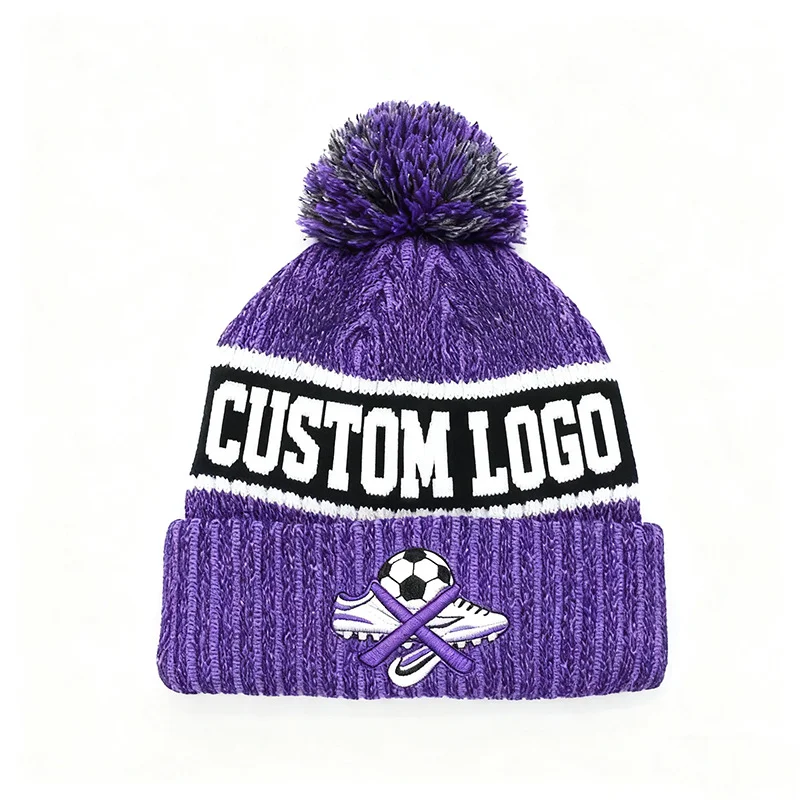
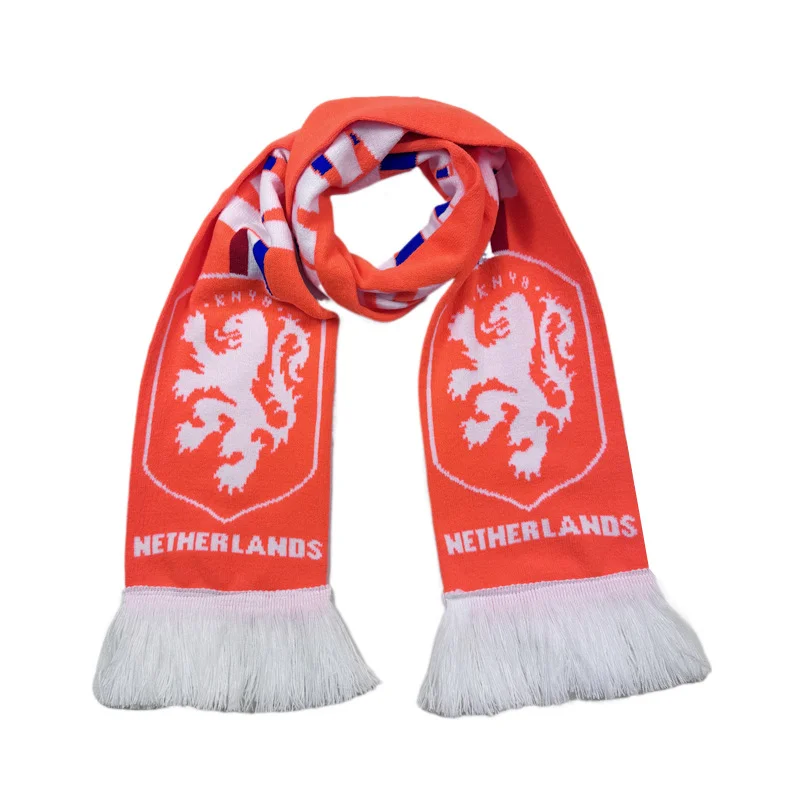
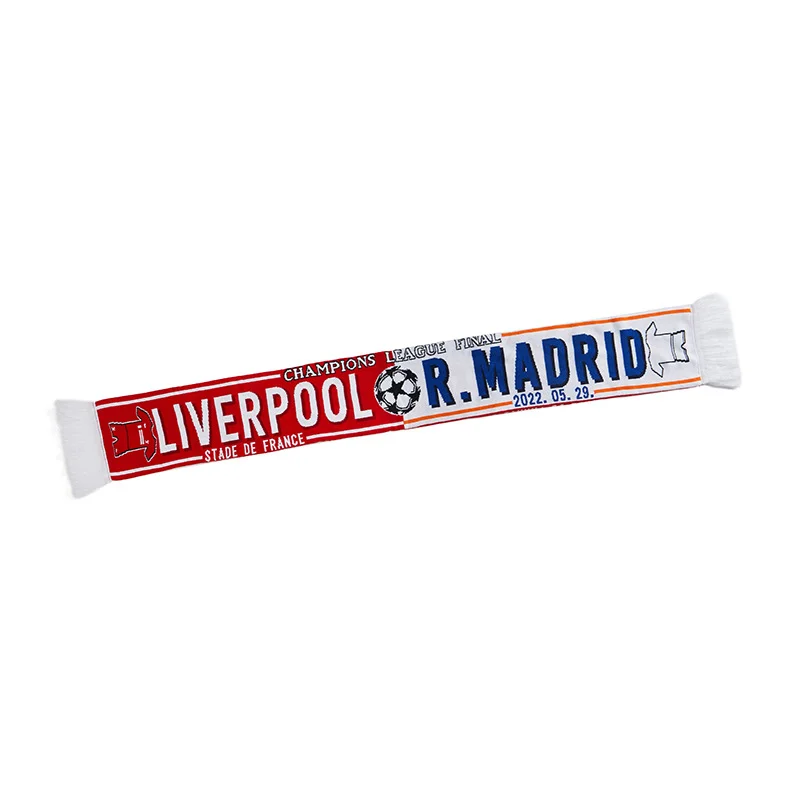
Knitted football scarves are the safer choice when the buyer wants the traditional stadium identity. They work well for club names, bold slogans, color bars, simplified crests, year marks and scarf designs that supporters expect to hold above their heads. The design becomes part of the scarf structure rather than sitting only on the surface.
Knitted construction also supports a warmer hand feel. That matters for winter match days, club shops and supporter groups in colder markets. A scarf that feels substantial can carry more perceived value than a very light printed giveaway. For repeat club merchandise, this traditional feel is often the reason buyers choose knit even when printed options look cheaper on paper.
However, knit has limits. A crest with very small lines, shadows, gradients or tiny sponsor text may need simplification. The supplier should check the artwork before quoting final production. If the factory simply accepts a complex design without explaining what will change, the sample may disappoint the club buyer later.
For production reference, compare a knitted football club scarf or striped jacquard football scarf before finalizing the artwork. These examples show how bold color blocks and simple lettering translate better than fine illustration detail.
When printed scarves win
Printed football scarves win when the artwork is visually complex. If the buyer wants player photos, stadium images, gradients, sponsor graphics, tournament posters or detailed commemorative artwork, print may protect the design better than knit. The scarf can carry more colors and more subtle image transitions.
Printed scarves are also useful for short-term event programs. If a match, tournament or sponsor activation needs graphic detail and the product is not intended to become a classic season scarf, print can be practical. The buyer can prioritize image fidelity and event storytelling over traditional yarn texture.
The tradeoff is perceived product type. A printed scarf may not feel like a classic supporter scarf. Depending on material and finish, it can feel more like an event accessory, promotional textile or fashion scarf. That may be exactly right for some campaigns and wrong for a club shop staple. Buyers should decide whether supporters expect a traditional knit or a graphic-led product.
Artwork and brand control
Brand control is different for each method. For knitted scarves, the key is simplification without damaging identity. The supplier may need to reduce fine lines, enlarge letters, remove gradients or convert a crest into stronger color blocks. The buyer should approve those changes before sampling. This is especially important for licensed clubs or sponsor marks.
For printed scarves, the key is file quality. Low-resolution artwork can look soft or pixelated when enlarged to scarf size. Color may also shift depending on fabric, ink and printing method. The buyer should send high-resolution files, vector logos where possible and clear color references. A print proof should be reviewed under realistic lighting, not only on a screen.
In both cases, the buyer should identify which elements matter most. Is the crest the priority? Is sponsor visibility required? Is the slogan more important than a decorative background? Without hierarchy, the scarf becomes crowded and the supplier cannot make good technical choices.
Cost and MOQ
Do not compare knitted and printed quotes unless the specification is normalized. Size, material, weight, packaging, label scope, quantity, sample requirement and delivery date can all change cost. A printed scarf with premium fabric and individual packing may cost more than a simple knitted scarf. A heavy knitted scarf with double-sided artwork and retail labels may cost more than a basic print.
MOQ should also be discussed by method and design. For wholesale manufacturing, a standard MOQ such as 500 pcs often supports setup, sample approval, production planning and QC. Printed and knitted routes may have different setup logic. Multiple designs, colorways or sponsor versions can split the MOQ even if the total order quantity looks large.
If the buyer wants cost control, the best strategy is not always choosing print or knit by default. It is simplifying the design, reducing colorway splits, using standard dimensions, confirming packaging early and avoiding last-minute label changes. That protects both price and schedule.
QC and sampling
Knitted scarf QC should check yarn shade, stitch density, scarf size, logo readability, text alignment, fringe strength, edge shape, label position and packing count. Printed scarf QC should check print clarity, color consistency, fabric hand feel, edge finish, transfer quality if relevant, label placement and packing accuracy. The checklist changes because the failure points change.
Sampling should be treated as a production standard. For knit, the sample confirms whether the artwork can survive yarn construction. For print, the sample confirms whether the file, fabric and print process create the expected visual result. A buyer who approves only a mockup is accepting risk. A mockup shows intention; a sample shows production reality.
Durability and reorder planning
Durability should be judged against the buyer goal. A knitted scarf may feel more durable for match-day use because the design is integrated into the scarf body and the product has a traditional weight. That makes it strong for season merchandise and supporter group reorders. A printed scarf can also perform well, but the buyer should check print method, fabric, edge finish and care instructions before assuming it will behave like a knit scarf.
Reorder planning is often easier with knitted or jacquard club scarves when the design is stable. The supplier can store yarn references, logo conversion files, scarf dimensions and label positions. Printed scarves can also be reordered, but color consistency may depend heavily on file control, fabric batch, print process and approval standards. In both routes, the buyer should keep the approved sample and final artwork file.
If the scarf is part of a long-term club shop program, ask how the supplier records the production standard. If it is a one-time event, ask how the supplier protects the deadline and graphic result. The better method depends on whether the buyer values repeatability, graphic detail or speed most.
Channel and packaging fit
The sales channel should influence the construction choice. Club shop scarves often need hang tags, barcodes, clean folding and a product feel that supports retail pricing. Supporter group scarves may prioritize identity, quantity and event delivery. Sponsor scarves may need more printed brand detail. Distributor programs may need consistent carton marks and SKU separation across several designs.
Packaging also changes the comparison. A printed scarf with a premium card insert may look more retail-ready than a basic knit with no tag. A knitted scarf with a strong woven label and clean polybag can feel more valuable than a thin printed scarf. Buyers should compare the complete product package, not only the scarf body.
Buyer scenarios
Choose knitted scarves for a club shop core item, supporter group order, traditional bar scarf, season scarf or repeat merchandise program. The product will feel familiar to supporters and easier to reorder if the approved sample is stored properly.
Choose printed scarves for a commemorative match, player tribute, sponsor activation, tournament graphic, photo-heavy event or campaign where visual detail matters more than classic knit texture. Printed production can communicate a story that would be too complex for yarn.
Consider double-sided or hybrid planning when the buyer needs both classic club identity and sponsor/event detail. One side can carry the core club message while the other side carries a campaign message. This requires stronger artwork proofing but can solve competing priorities.
Final recommendation
Knitted vs printed is not a winner-takes-all decision. It is a fit decision. Knitted scarves are best for classic supporter identity, bold artwork and repeat club merchandise. Printed scarves are best for detailed graphics, photos and short-term campaigns. B2B buyers should send artwork, quantity, label needs, packing method and deadline to the supplier, then ask which method protects the commercial goal with the least production risk.
Data Snapshot
Created 2026-06-29 as a long-form B2B comparison article for knitted vs printed football scarf buyer decisions. Approximate body length after HTML cleanup: 1508 words.
Frequently Asked Questions
Are knitted football scarves better than printed football scarves?
Knitted scarves are better for classic supporter merchandise with bold text and stripes. Printed scarves are better for photos, gradients and complex event artwork.
Which scarf type is better for sponsor graphics?
Simple sponsor marks can work in knit or jacquard. Detailed sponsor graphics, gradients or photographic artwork usually work better with printed scarves.
How should clubs compare knitted and printed quotes?
Compare the same size, quantity, material, label scope, packing method, sample requirement and delivery date. Construction alone does not determine final cost.
Start Your Football Scarf Project
Send your artwork and target use case to compare knitted and printed football scarf production routes.
Data verified as of 2026-06-29. MOQ, lead time, compliance scopes and production details should be checked against current order requirements before purchase order confirmation.